Return to the Palm: Five Years at The St. Regis Dubai, The Palm
– 5 min read

On a quiet anniversary, a property that has learned to read Dubai rather than compete with it
"He who does not know his past cannot make the best of his present and future." — Sheikh Zayed bin Sultan Al Nahyan
Most hotels on Palm Jumeirah ask to be admired. Fewer ask to be read. I returned to The St. Regis Dubai, The Palm this season for the second time in eighteen months, and the difference between those two registers, performance and legibility, is what made me stay longer than I had planned.
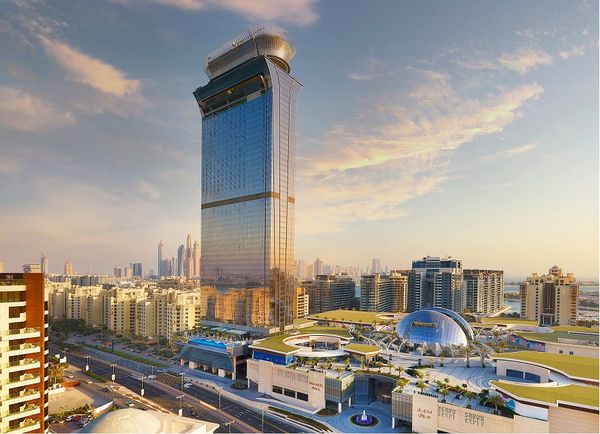
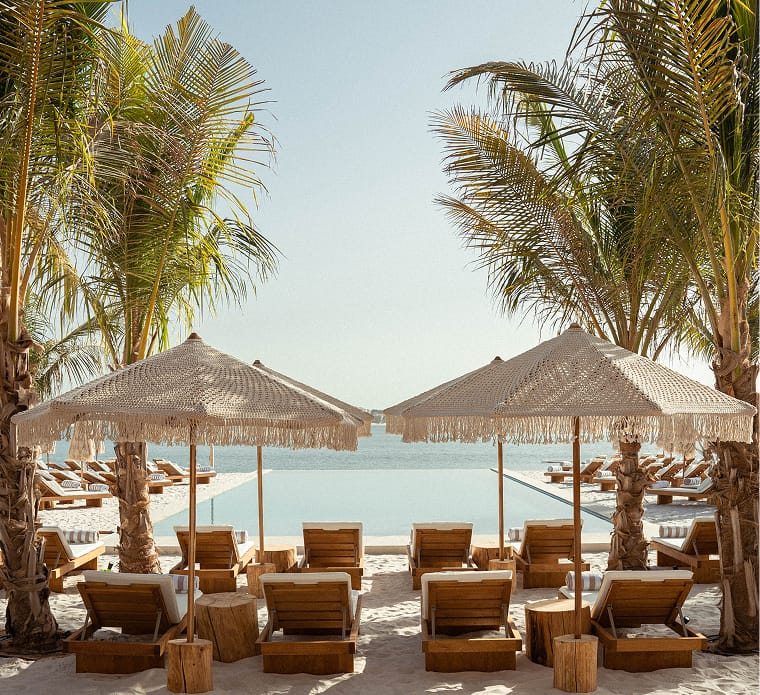
The property marks its fifth anniversary on 16 May 2026. That is a measured figure in a city where newness is usually the loudest argument. The hotel occupies levels four to eighteen of The Palm Tower, the 52-storey landmark at the central trunk of Palm Jumeirah, with residences and the observation deck rising above. There is a logic to being housed inside a vertical city of this kind. The hotel does not need to manufacture a sense of event. The tower, Palm Jumeirah Mall at its base, Al Ittihad Park alongside, KYMA Beach on Palm West, the AURA Skypool on level 50, SUSHISAMBA on 51, and The View at the Palm on 52, arranges event around it.
What makes this address editorially interesting, however, is not its geography. It is the way it handles time.
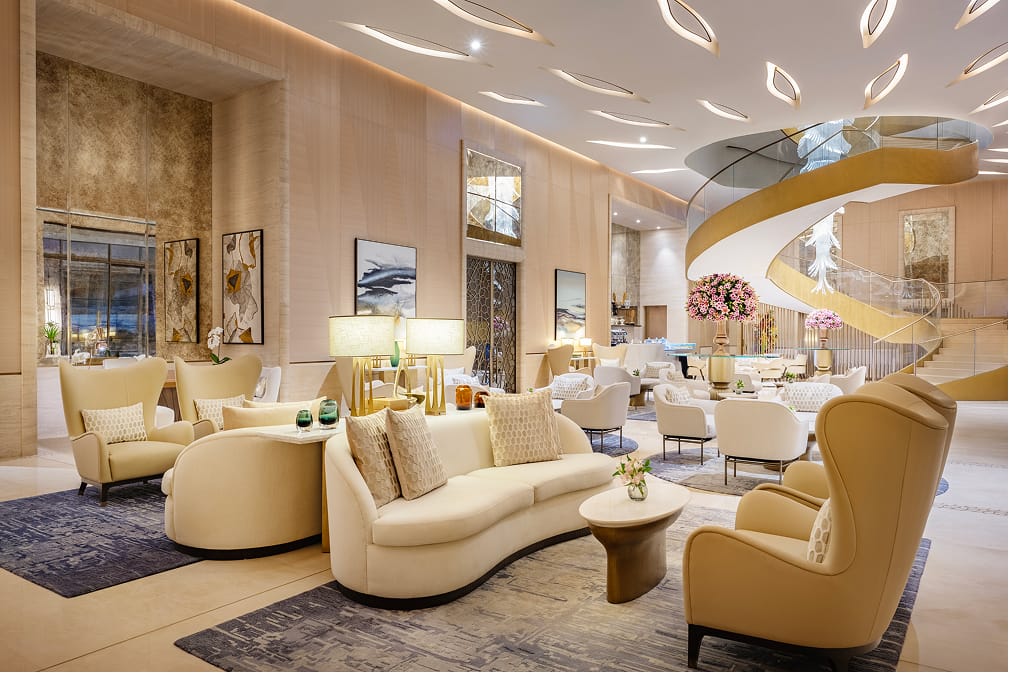
The approach is unchanged. A private corniche road, palm rows pruned to parade geometry, the tower rising vertically rather than sprawling. Inside, the limestone lobby has softened across repeated visits, which is a thing one only notices on a return. A spiralling gold staircase, crowned by a chandelier of hundreds of suspended glass shards, remains the most photographed object in the room. It could have been theatrical. In practice it reads as a column of still water.
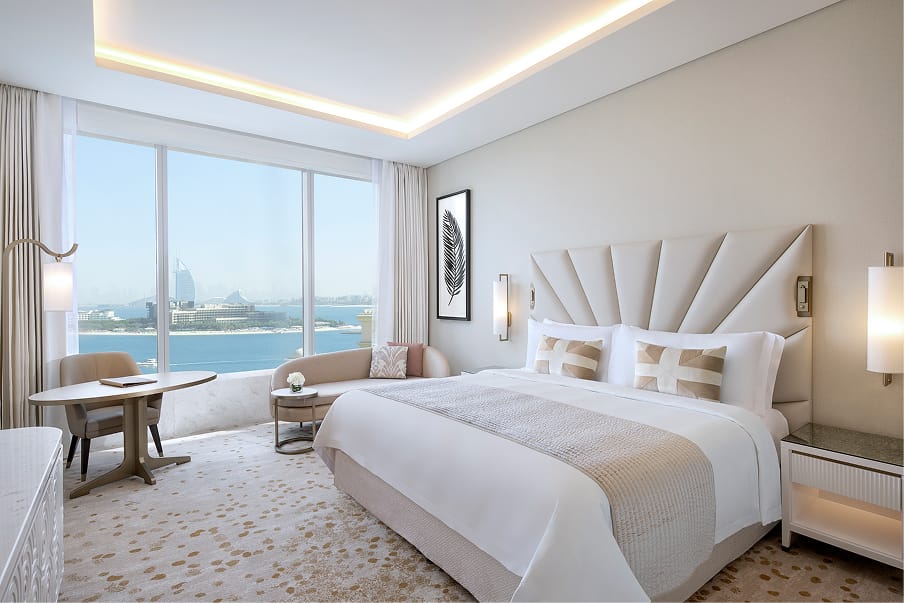
The rooms are disciplined. Entry-level Deluxe categories measure 43 square metres, the Astor Suite 148, the Presidential Suite 248. Floor-to-ceiling windows frame either the Arabian Gulf toward Burj Al Arab or the curving fronds of Palm Jumeirah. The palette is pale and almost salt-toned. Frette linens, feather-soft mattresses, walk-in wardrobes the size of a small study. The 290 keys include two Grand Astor Suites and a single Presidential Suite on the upper floors, where the view turns less architectural and more oceanic.
The real instrument on which this hotel now plays, though, is the evening.
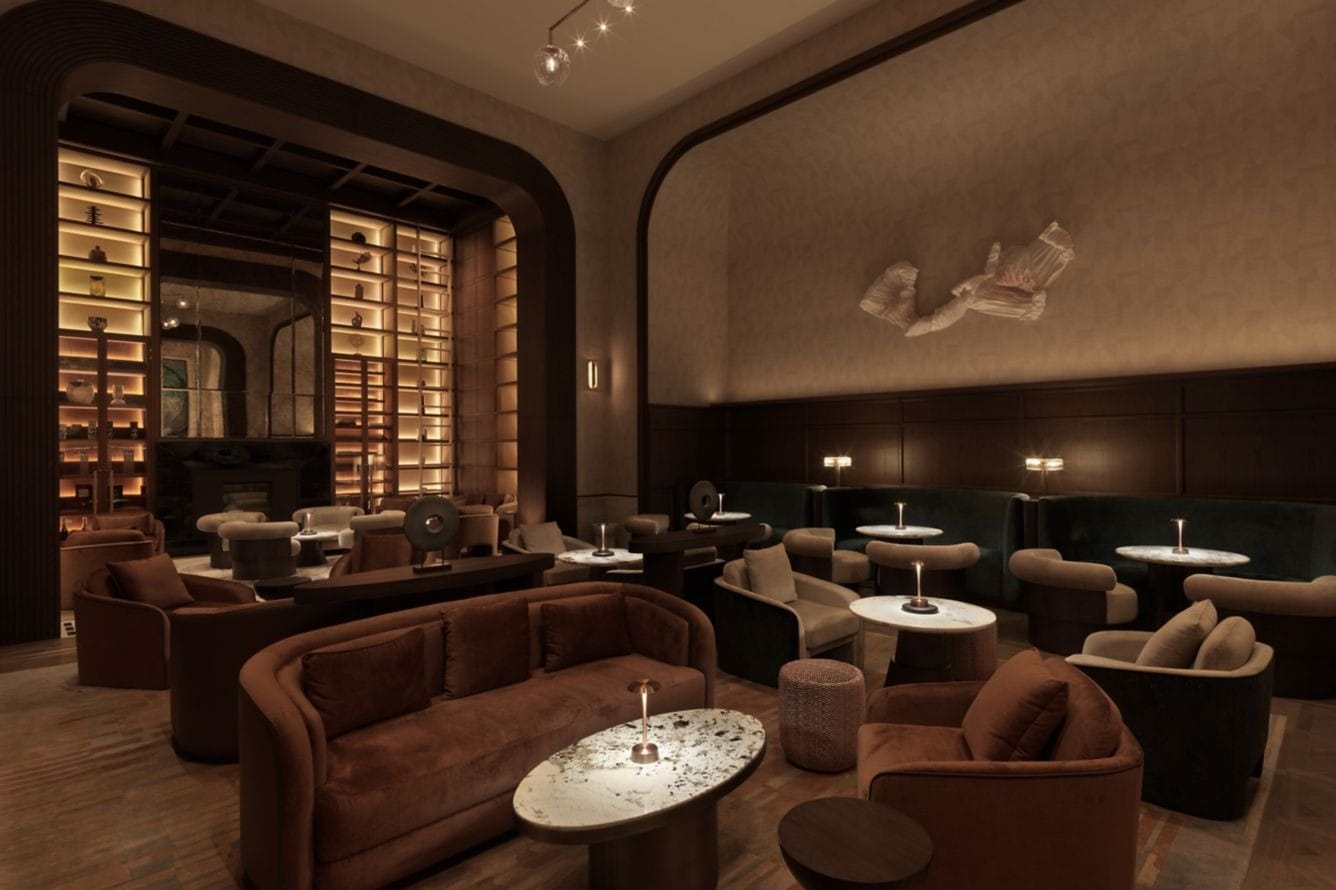
Since opening, The St. Regis Bar has been the social centre of gravity. It closed briefly this cycle for a redesign and reopened with a single decisive addition: a bespoke mural drawn from the Al Duroor calendar, the traditional navigational almanac by which Emirati seafarers once read the stars and timed their seasons. The artwork braids three motifs: the Ghaf tree, the Arabian Oryx, and a mid-flight kingfisher. The decision to place this piece of local epistemology above the bar, rather than in a lobby vitrine, is telling. It sets the tone of every evening that passes beneath it.
At 18:45 each day, the house observes the champagne sabering ritual, a gesture St. Regis inherited from Napoleonic France and now performs across its global portfolio. At this property, it takes place under the new mural. The gesture is brief, perhaps thirty seconds, and marks the transition from day to evening. One could call it theatre. I prefer to call it punctuation. Cities as porous as Dubai need punctuation. Without it, the working day simply bleeds into the night.
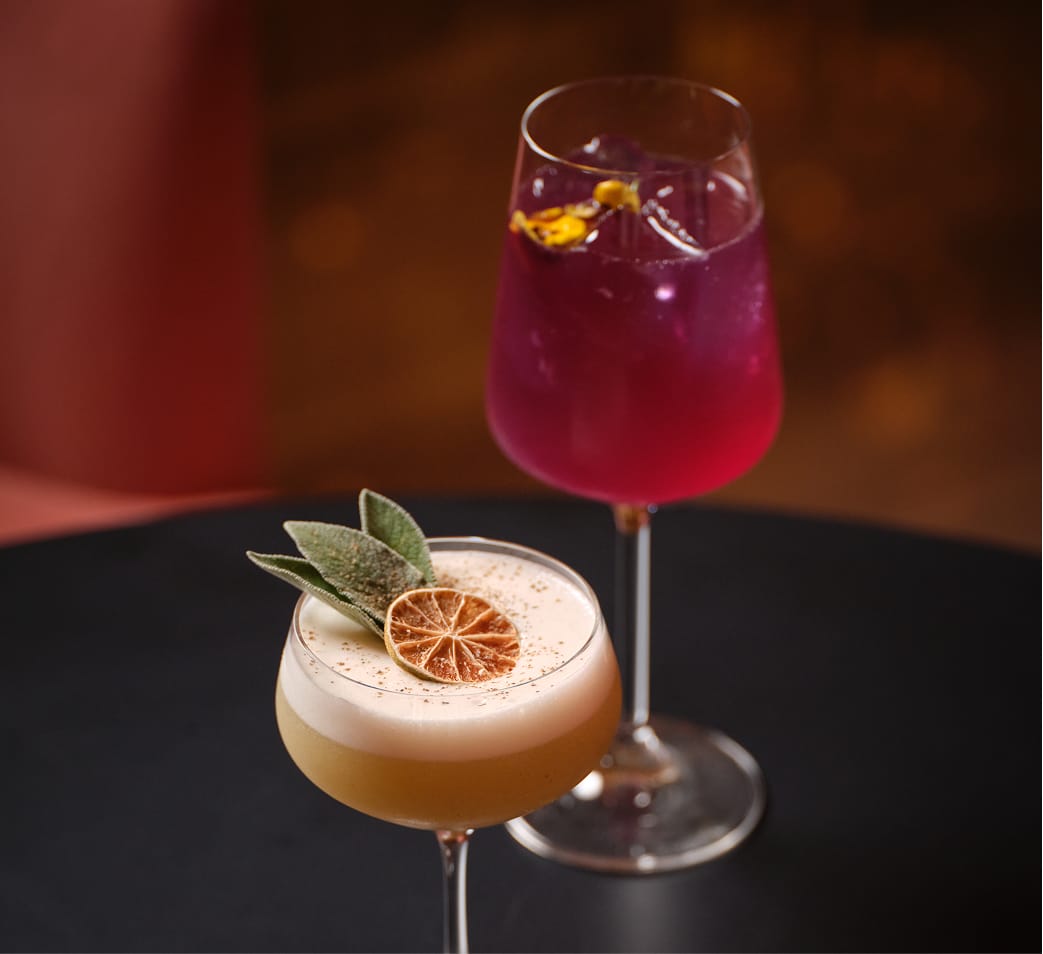
The house cocktail is called The Glitzy Mary, the property's local rereading of the Bloody Mary first mixed at The St. Regis New York in 1934 by Fernand Petiot. Local here means something specific: dried lime, Arabian spice, a short and intelligent finish. In the Gulf there is a saying, الصبر مفتاح الفرج, patience is the key to relief. Good bartending understands the same idea.
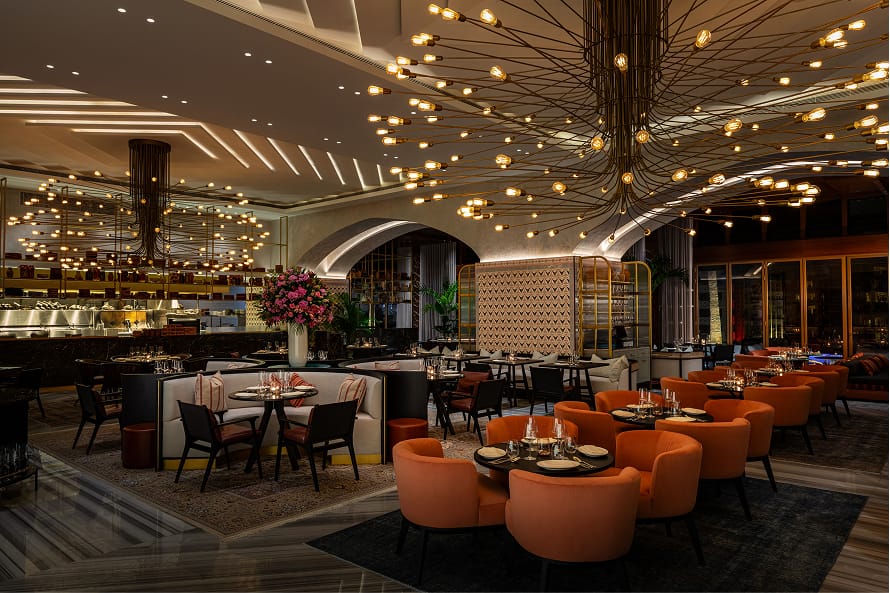
Dinner, over four evenings, moved between registers. Rüya, on level three, remains among the strongest contemporary Anatolian kitchens in the city, its wood-fired lamb and Turkish wine list establishing a conversational tempo rather than a performative one. Cordelia, the all-day international room, carries the property's breakfast and a more straightforward dinner. The elevated surprise, however, is St. Regis Gardens, the rooftop dining precinct developed with Nakheel, which now houses Trèsind Studio (three Michelin stars), SMOKEDROOM (one Michelin star), and the chef-led rooms Signor Sassi, Chez Wam, LEÑA Fire x Dani Garcia, Aretha and Hanu. On a single address, the property hosts one of the most coherent Michelin corridors on Palm Jumeirah.
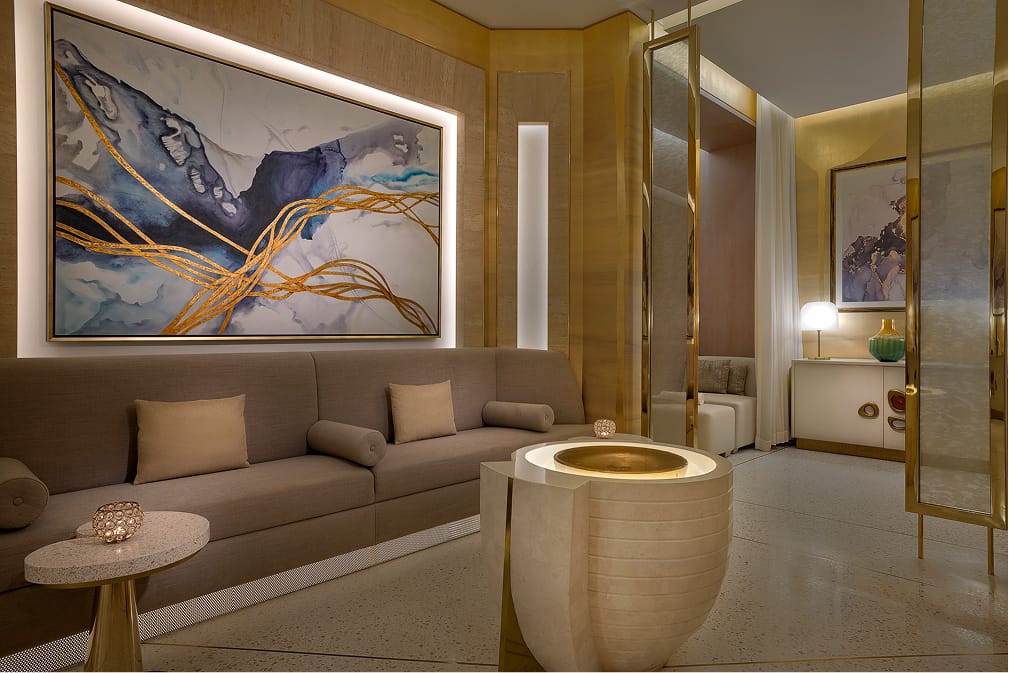
Wellness occupies level two. The St. Regis Spa runs 791 square metres across three treatment suites, with a menu built around SOTHYS and AMRA and signature protocols that include the 24-karat Rejuvenating Gold body ritual. In February, Forbes Travel Guide confirmed its Four-Star rating for the third consecutive year. The hotel itself received the Five-Star designation for the same third year. In a city where new towers open weekly, consecutive awards are the more accurate measurement.
General Manager Marwan Fadel, who has led the property through both its pandemic-era opening and its recent refit, frames the trajectory in an understated register. The focus, he said of the 2026 recognition, remains on thoughtful service, culinary coherence and meaningful wellness. Corporate language, read closely, usually tells you what a hotel is rehearsing rather than what it has achieved. Here, after five years, the two have begun to coincide.
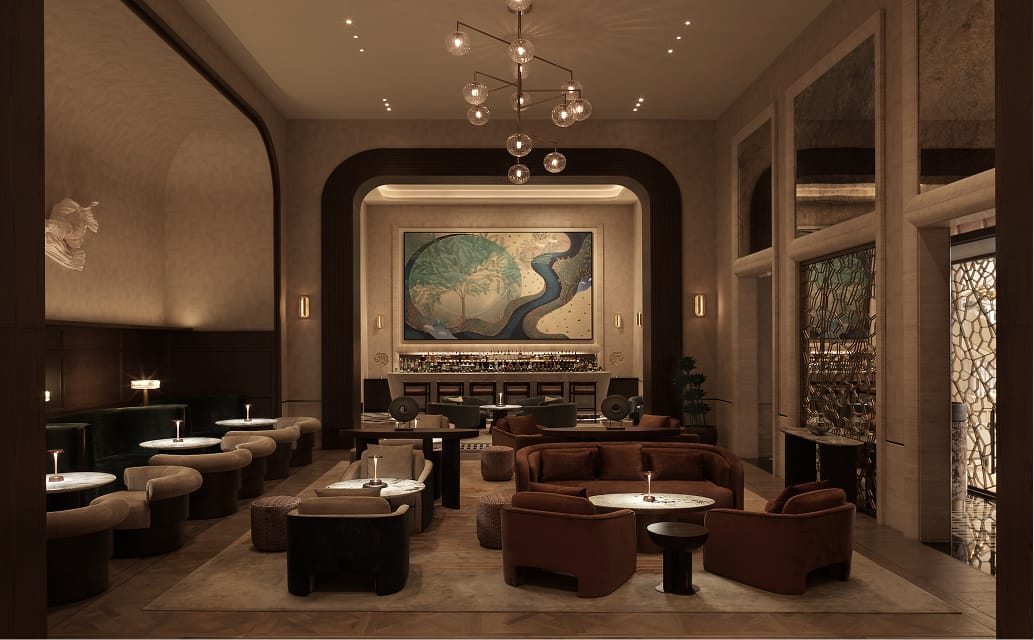
What I found at Palm Jumeirah this season was not a hotel proving itself. It was a hotel that has understood where it is. The Al Duroor mural is the quiet emblem of that understanding. Good hospitality does not import meaning. It reads the ground it stands on.
Five years in, The St. Regis Dubai, The Palm knows how to read its evenings. In a city still learning to slow its own tempo, that is the discipline worth watching.